
No products in the cart.
Return To Shop- 0449 255 652
- FREE SHIPPING FOR ALL ORDERS OF $150
- 9:00AM - 5:00PM
- CONTACT US
- FAQS

Wishlist
Please, enable Wishlist.
Tiger Barb (Capoeta tetrazona)
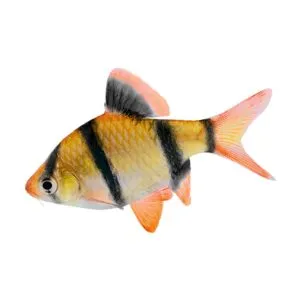
TROPICAL SCHOOLING FISH
Other names: Sumatra Barb, partbelt barb
Minimum volume requirement: 50L for a small school, larger tanks and larger schools are best to avoid aggression
Size: up to 7cm
pH: 6 – 7.5
Temperature: 24°C – 27°C
Life span: 5-7 years

Description
The tiger barb (Puntigrus tetrazona) is a classic aquarium favourite, instantly recognisable for their striking colouration and big personality. Their common name derives from the four distinctive black, vertical bars that run across their golden-orange body, resembling a tiger’s stripes.
Over decades of selective breeding in the aquarium trade, this species has produced several popular color variants, including the albino, green (moss), and golden (leucistic) tiger barb. They reach a maximum size of about 7 cm in total length.
Distribution
Native to tropical Southeast Asia, specifically the islands of Sumatra and Borneo. Their natural habitats are typically clearwater streams with fairly acidic water. Due to its immense popularity in the aquarium trade, the species has been introduced widely outside its native range and is now found in several other countries.
Diet
Tiger barbs are omnivores and are notably unfussy eaters, eagerly accepting almost any food offered. In their natural environment, they feed on a variety of items, including phytoplankton, aquatic insects, terrestrial insects, and other aquatic invertebrates. In captivity, a high-quality flake food or small pellets, supplemented with a nice frozen food will do fine. They are competitive, fast feeders, so care should be taken to ensure that slower tankmates get their share.

Hikari Vibra Bites
$12.95 – $59.95Price range: $12.95 through $59.95 Select options This product has multiple variants. The options may be chosen on the product page
New Life Spectrum Thera A Regular
$19.95 – $187.95Price range: $19.95 through $187.95 Select options This product has multiple variants. The options may be chosen on the product pageTiger Barbs in Captivity
Tiger barbs are a hardy, semi-aggressive species that are best kept in groups of at least 6 individuals. Barbs have a natural pecking order within their school, a bit of chasing and nipping within the group is normal. If your tank or school is too small however this fin nipping may become extreme or extend to other fish who are otherwise minding their own business! We reccomend keeping a minimum of 6 barbs at a time to keep this agression contained to the group. When selecting tankmates, it is good to avoid slow-moving fish with long, flowing fins, such as angelfish, bettas, and fancy guppies, as they will most likely fall victim to the ‘boisterous’ nature of your barbs… Suitable companions are similarly sized fast-moving fish like giant danios, larger robust tetras, and bottom-dwelling catfish. They do particularly well with the very similar-looking clown loach!
The tank should be well-decorated with live plants, driftwood, and rocks to provide cover and visual barriers, while leaving an open area in the centre for swimming. They thrive in water with a pH of 6.0-8.0 and a temperature of 72-79°F (22-26°C).
Search
©Copyright 2023 by The Fish Works Pty Ltd All Rights Reserved.
