
No products in the cart.
Return To Shop- 0449 255 652
- FREE SHIPPING FOR ALL ORDERS OF $150
- 9:00AM - 5:00PM
- CONTACT US
- FAQS

Wishlist
Please, enable Wishlist.
The Fish Works
Biological Filtration for Fish Ponds
What it is, how it works and how to use it in your pond or aquarium.
Biological filtration is the most important — and most overlooked — component of any fish pond filter system. While mechanical filtration removes visible debris and UV filtration prevents green water, it is biological filtration that tackles the invisible threats: the toxic compounds that build up in your pond water and endanger your fish.
Table of Contents
How Does Biological Filtration Work?
Every fish pond produces waste. Fish excrete ammonia directly through their gills and via their faeces, and as organic matter such as uneaten food and leaves decomposes, it too breaks down into ammonia. Left unchecked, ammonia accumulates rapidly and becomes lethal to fish, even at very low concentrations.
Biological filtration solves this problem using nature’s own solution: beneficial bacteria. These bacteria colonise the surfaces of your pond and filter media, and work continuously to convert toxic compounds into progressively safer forms through a process called nitrification.

The Nitrification Cycle Explained
Nitrification is a biological process that converts harmful fish waste into compounds that are largely harmless, and even beneficial to pond plants.
| 1 | Ammonia (NH₃) Highly toxic to fish | Fish waste and decomposing organic matter release ammonia directly into the pond water. Even small concentrations can cause gill damage, stress and death in fish. This is the starting point of the nitrification cycle. |
| 2 | Nitrite (NO₂) Toxic to fish | Nitrosomonas bacteria convert ammonia into nitrite. While less immediately lethal than ammonia, nitrite is still highly toxic, it interferes with the ability of fish blood to carry oxygen, essentially causing them to suffocate. |
| 3 | Nitrate (NO₃) Low toxicity — plant food | Nitrobacter bacteria then convert nitrite into nitrate, a compound that is largely harmless to fish at normal concentrations and is actively used by aquatic plants as a nutrient for growth. A well-planted pond helps complete the cycle naturally. |
The Bacteria Responsible
There are two primary types of beneficial bacteria responsible for the nitrification process in a fish pond:
Nitrosomonas
Responsible for Stage 1 of nitrification. These bacteria oxidise ammonia and convert it into nitrite. They are the first line of biological defence in your pond and are essential for preventing dangerous ammonia spikes.
Ammonia → Nitrite
Nitrobacter
Responsible for Stage 2 of nitrification. These bacteria convert the nitrite produced by Nitrosomonas into nitrate — a far safer compound that aquatic plants readily absorb as a fertiliser.
Nitrite → Nitrate
Both types of bacteria occur naturally in every established pond. They live on every submerged surfaces such as rocks, logs, plant stems, pond walls and filter media. The challenge in most fish ponds is that the volume of waste and nutrients produced by the fish exceeds the capacity of the naturally occurring bacteria to process it, which is where biological filter systems come in.
Biological Filter Media
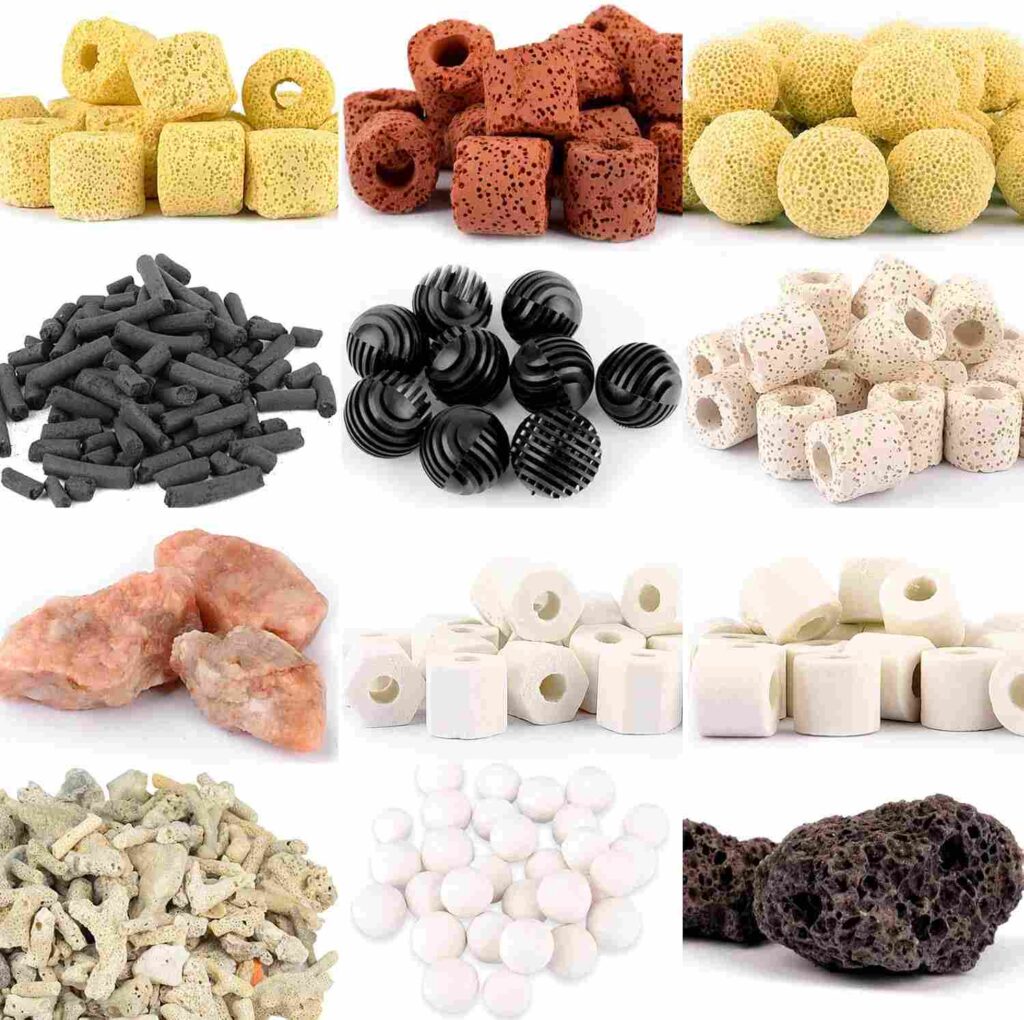
The key principle behind all biological filtration is simple: more surface area = more bacteria = better filtration. To increase the colony size of beneficial bacteria, we provide them with specially designed materials that pack an enormous amount of surface area into a small space.

Common types of biological filter media include:
| Bioballs | Plastic spheres with a highly intricate internal structure, designed to maximise surface area while allowing water to flow freely through them without clogging. One of the most popular and durable forms of biological media. |
| Japanese Matting | A dense, open-cell foam matting with a massive surface area. Excellent for both mechanical and biological filtration — it traps debris while simultaneously housing huge colonies of beneficial bacteria. |
| Plastic Cell Media | Rigid plastic structures similar to bioballs but in different configurations. Lightweight, long-lasting, and effective at housing large bacterial colonies with excellent water flow characteristics. |
| Filter Brushes | Long bristled brushes often used in the first stage of a gravity filter. They trap larger particles mechanically while the bristles provide extensive surface area for bacterial colonisation. |
| Biological Sponges | Open-cell foam sponges used in many pressurised filter systems. They provide both mechanical and biological filtration and are easy to clean without disrupting the bacterial colony too significantly. |
⚠️ Important: When cleaning biological filter media, always rinse it in a bucket of pond water — never tap water. Chlorine in tap water will kill your beneficial bacteria colony, setting your biological filtration back weeks and potentially causing dangerous ammonia spikes in your pond.
Biological Filtration Systems
In most fish ponds, the volume of waste and nutrients released by fish is too great for the naturally occurring bacteria in the pond to handle alone. Biological filtration systems solve this by dramatically increasing the surface area available for beneficial bacteria to colonise.
Water pumped through the filter box flows past this dense colony of bacteria, which collectively work to convert ammonia through to nitrite and finally into the relatively harmless nitrate, keeping your pond water safe, clear and balanced.
The larger and more densely stocked your pond is, the greater the biological filtration capacity you will need. This is why correctly sizing your filter to your pond volume and fish load is so critical, an undersized biological filter is one of the most common causes of poor water quality and fish health problems.
Our Expertise in Biological Filtration
Biological filtration is The Fish Works’ area of expertise. We have designed and built custom biological filter systems for literally hundreds of fish ponds across NSW — each one tailor-made to achieve crystal-clear water and a healthy, thriving environment for the fish within it.
We stock a wide range of biofilters for water features and fish ponds of all sizes — from small all-in-one units for compact water features, through to large custom gravity filter systems for serious koi ponds.
Want to make sure your pond has the right biological filtration for your fish load? We’re here to help.
Get in touch for free expert advice anytime — or come visit us in store.
Ready to shop?
©Copyright 2023 by The Fish Works Pty Ltd All Rights Reserved.
